Battery thermal management is the mission-critical process of maintaining electrochemical cells within their optimal operational and safety envelopes. Advanced phase change materials (PCM) achieve this passively, absorbing massive heat fluxes as they transition from solid to liquid and cleanly releasing that energy as they cool. This engineering guide analyzes why cell temperature uniformity matters, how latent heat thermal dissipation functions, and where passive integration fits alongside traditional active air and liquid cooling loops.
Lithium-ion cells perform with maximum efficiency and safety within a relatively narrow thermal band – roughly 15°C to 35°C. When a battery pack operates at sustained elevated temperatures, electrolyte degradation accelerates, capacity fades prematurely, and internal resistance climbs.
In extreme scenarios, localized overheating can breach a cell’s separator membrane, triggering an uncontrollable exothermic reaction known as thermal runaway. Conversely, sub-zero operations severely restrict ionic conductivity, reducing available discharge power and causing dangerous lithium plating during charge cycles. Maintaining precise temperature uniformity across all cells prevents localized cell degradation and maximizes the overall lifespan of the pack.
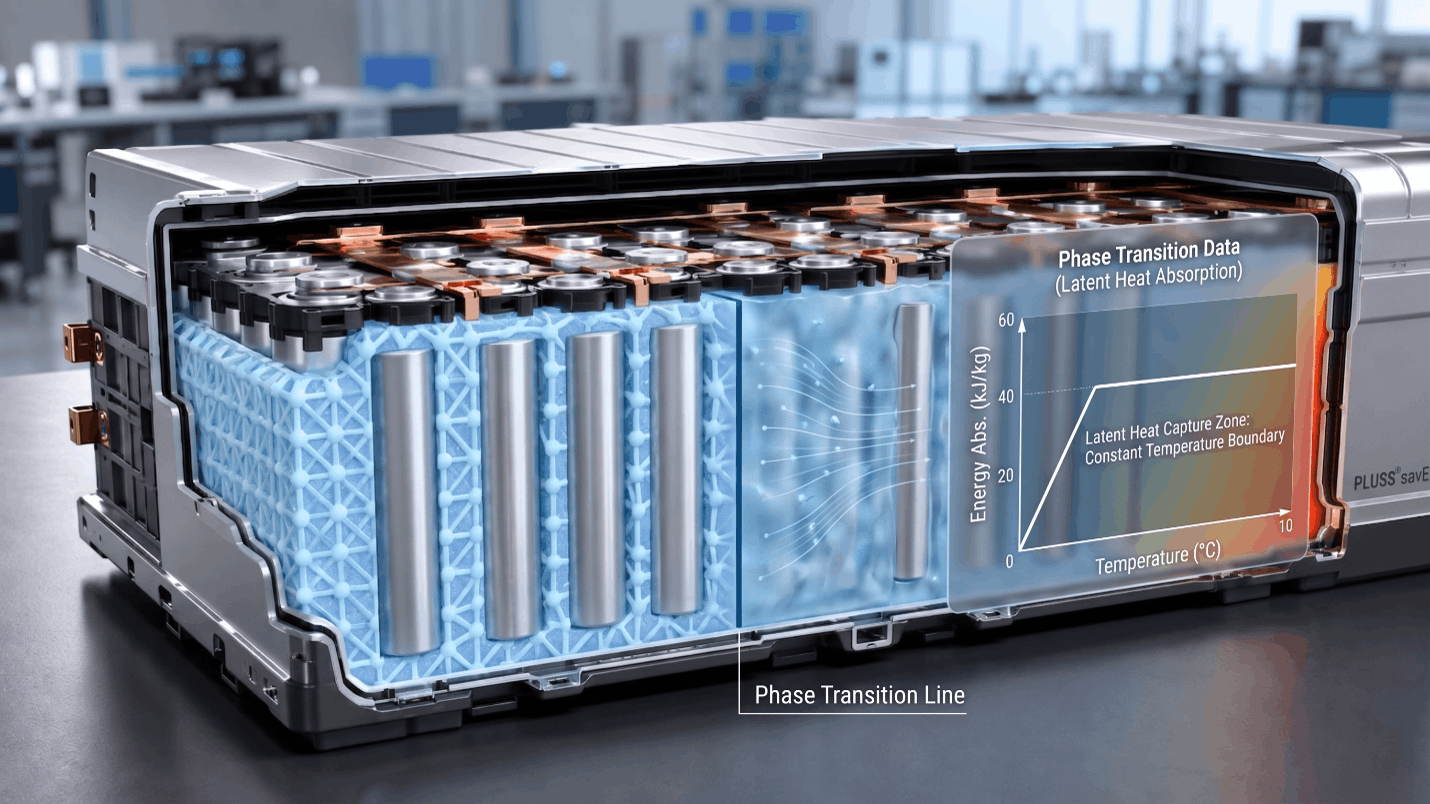
In a passive thermal management design, the material is cast directly into the interstitial spaces surrounding individual cells or embedded within module divider plates. As the battery discharges under heavy structural load and cell surface temperatures rise toward the material’s phase transition point, the PCM absorbs the thermal energy.
Instead of allowing the cell temperature to spike, the material stores this energy as latent heat at a near-constant phase boundary temperature. This effectively shaves off peak thermal loads through passive mode cooling. Once the electrical demand subsides and ambient temperatures drop, the material solidifies again, releasing the stored heat safely to the outer chassis and resetting itself completely for the next operational cycle.
Air cooling loops are simple and cost-efficient, but their low heat transfer coefficients limit them to low-drain applications. Conversely, active liquid cooling plates handle large, sustained thermal loads but introduce severe engineering complexity, packaging weight, high parasitic power draws, and the persistent risk of fluid leaks inside high-voltage enclosures.
Integrating a passive PCM matrix offers a balanced alternative, providing a self-contained thermal management solution. For high-performance applications, a hybrid approach is ideal: utilizing a PCM matrix to buffer immediate, rapid heat spikes locally, while a scaled-down active system handles steady-state heat removal over long operational durations.
Passive PCM battery thermal management is widely deployed across sectors where reliability, maintenance-free operation, and explosion-proof safety margins are paramount:
PLUSS manufactures a proprietary line of chemical and bio-based savE® phase change materials engineered specifically to match the thermodynamic boundaries of modern lithium-ion chemistries. To provide maximum thermal stability during transient spikes, engineers generally select material formulations with phase transition points situated directly above optimal operational temperatures (typically between 30°C and 50°C).
The table below outlines the core thermodynamic, physical, and chemical properties extracted from official PLUSS Technical Datasheets (TDS) for battery-grade organic matrices.
Core Engineering Properties: savE® Battery Optimization Grades
| Thermodynamic & Physical Property | savE® OM32 (Standard Duty) |
savE® OM49 (High-Capacity Safety) |
Test Method / Conditions |
|---|---|---|---|
| Material Classification | Organic Compound | Organic Compound | Chemical Stability Assessment |
| Nominal Melting Point | 33°C | 49°C | PLUSS T-History (Air Bath) |
| Nominal Freezing Point | 30°C | 46°C | PLUSS T-History (Liquid Bath) |
| Latent Heat / Enthalpy (Melting) | 156 kJ/kg | 224 kJ/kg | PLUSS T-History (@ 28–38°C) |
| Latent Heat / Enthalpy (Freezing) | 187 kJ/kg | 218 kJ/kg | PLUSS T-History (@ 38–28°C) |
| Density (Liquid State) | 870 kg/m³ | 865 kg/m³ | ASTM D891-95 (@ 40°C) |
| Density (Solid State) | 926 kg/m³ | 912 kg/m³ | ASTM D891-95 (@ 10°C) |
| Specific Heat (Liquid State) | 2.81 kJ/kgK | 2.89 kJ/kgK | PLUSS T-History (@ 37°C) |
| Specific Heat (Solid State) | 3.21 kJ/kgK | 3.15 kJ/kgK | PLUSS T-History (@ 27°C) |
| Thermal Conductivity (Solid) | 0.219 W/mK | 0.230 W/mK | KD2Pro Thermal Analyzer (@ 5°C) |
| Verified Cycling Stability | ~2,000 Cycles | ~2,000 Cycles | PLUSS Internal Accelerated Aging |
| Maximum Operating Limit | 90°C | 120°C | Continuous Exposure Matrix |
Available in specialized encapsulated aluminum profiles, flexible macro-packs, or custom form-fitting composite matrices, these materials are built to drop directly into commercial module form factors.
Does PCM replace liquid cooling in batteries?
Not in all applications. While PCM can fully replace active systems in light electric vehicles, telecom stations, and stationary storage, it is frequently used as a hybrid supplement in high-performance EVs. In a hybrid setup, the PCM absorbs rapid, high-intensity heat spikes, while a downsized active liquid system manages steady-state thermal removal over extended durations.
How does PCM improve overall battery safety?
By capturing heat energy at a fixed melting threshold, the PCM prevents an overheating cell from crossing the critical temperature limit required to ignite neighboring cells. This thermal insulation breaks the chain reaction necessary for full module propagation during a localized failure event.
Is PCM battery cooling completely maintenance-free?
Yes. Because our organic and inorganic phase change materials operate via a completely self-contained chemical phase change, there are zero moving components, valves, pumps, or seals to inspect, service, or repair over the operational lifespan of the battery system.
Engineer a cooler, safer battery pack with savE® PCM
PLUSS designs passive phase change material solutions that drop straight into your battery module – no pumps, no fans, no maintenance. Explore the range or talk to our thermal engineering team.



Celsure® Temperature Controlled Packaging
Pluss Advanced Technologies
B-205, Pioneer Urban Square, Sector – 62, Gurugram – 122101, (Haryana), INDIA
+91-124-4309490/91/92
info@pluss.co.in
CIN No:U74899TN1993PLC161495

© 2025. All Rights Reserved.
 ×
×